
The Beginning of My Conducting Journey
In this post, I reflect on the beginning of my conducting journey, sharing the experiences and lessons learned from my early engagements with orchestra repertoire. From Mozart's delicate works to Beethoven's profound symphonic structures, these initial steps in my conducting career were a mixture of excitement, challenge, and discovery. I delve into how each piece shaped my understanding of conducting as both a technical craft and an art of human connection.
ORKESTRA ŞEFLIĞI
Efe ÖZKAN
5/7/20252 min read
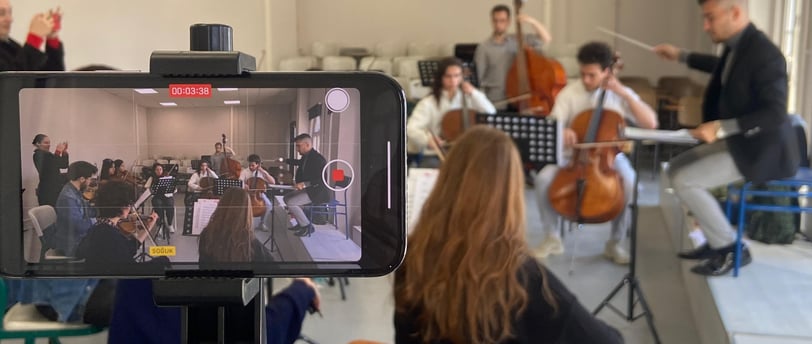
The Path to Conducting: Shaping Time, Commanding Silence
To the untrained eye, conducting may appear to be a graceful exercise in hand gestures. But to understand the depth of this discipline, one must experience the moment of silence before a first rehearsal—when the musicians’ eyes turn to you, and the responsibility of time, sound, and structure becomes your own.
For me, that moment arrived with Mozart’s Divertimento in D Major, KV 136.
I. First Encounters: When Practice Meets Thought
I began my conducting journey with the Classical string repertoire. This was not a random choice. Works such as Mozart’s Divertimento in D Major and Eine kleine Nachtmusik offer a transparent structure that both reveals and challenges the conductor’s interpretative instincts. Their elegance lies in balance—each phrase must be both spontaneous and controlled, alive yet architecturally sound.
Through these works, I came to understand that tempo is not merely a matter of counting. It is a living pulse. Conducting became less about motion and more about breathing with the music, about shaping silence as much as sound.
II. Dramaturgy on Stage: Learning from Donizetti
My first operatic experience came through Donizetti’s Don Pasquale, specifically Norina’s cavatina. This excerpt demanded more than musical fluency—it required dramatic intelligence. A conductor must not only support the singer but shape the emotional rhythm of the scene. I realized that in opera, conducting is not only technical; it is dramaturgical. One becomes a silent co-author of the theatrical narrative.
III. Managing Orchestral Density: The Beethoven Challenge
Beethoven’s Symphony No. 7, second movement, arranged for string orchestra, posed a new kind of challenge: control of emotional pacing, texture, and horizontal flow. Conducting this piece required the ability to sustain intensity over time—to weave an arch of energy that grows, dissolves, and reforms.
It was here that I first grasped the importance of shaping large-scale structure through small-scale precision. Conducting became a spatial art, not just a temporal one.
IV. The Poetry of Intimacy: Kreisler and Elgar
Kreisler’s Liebesfreud and Elgar’s Salut d’Amour offered a more intimate, expressive test. Though short in duration, these pieces require absolute nuance. One must communicate rubato, vibrato, and phrasing not through words, but with breath, gaze, and gesture.
Through these works, I learned that a conductor has no instrument—but every instrument becomes an extension of their intent. Interpretation becomes a silent language of micro-timing and sensitivity.
V. Conducting as Human Art
Conducting is not merely about technical mastery—it is a deeply human art. The connection with musicians, the emotional integrity of a rehearsal, and the trust built in silence are as crucial as any musical decision.
Looking back, my journey through these works was not just a technical initiation—it was a human transformation. To conduct is not to control music, but to move with it.
I had the privilege of working on this formative repertoire with the Yıldız Chamber Orchestra. I am sincerely grateful to Pia Düzgit for providing me with this opportunity. Taking my first steps in conducting with an ensemble that placed its trust in me was not only a professional milestone, but a foundational experience that shaped my artistic identity.
Musically yours,
Efe Özkan